
Nicholas Roerich and India.
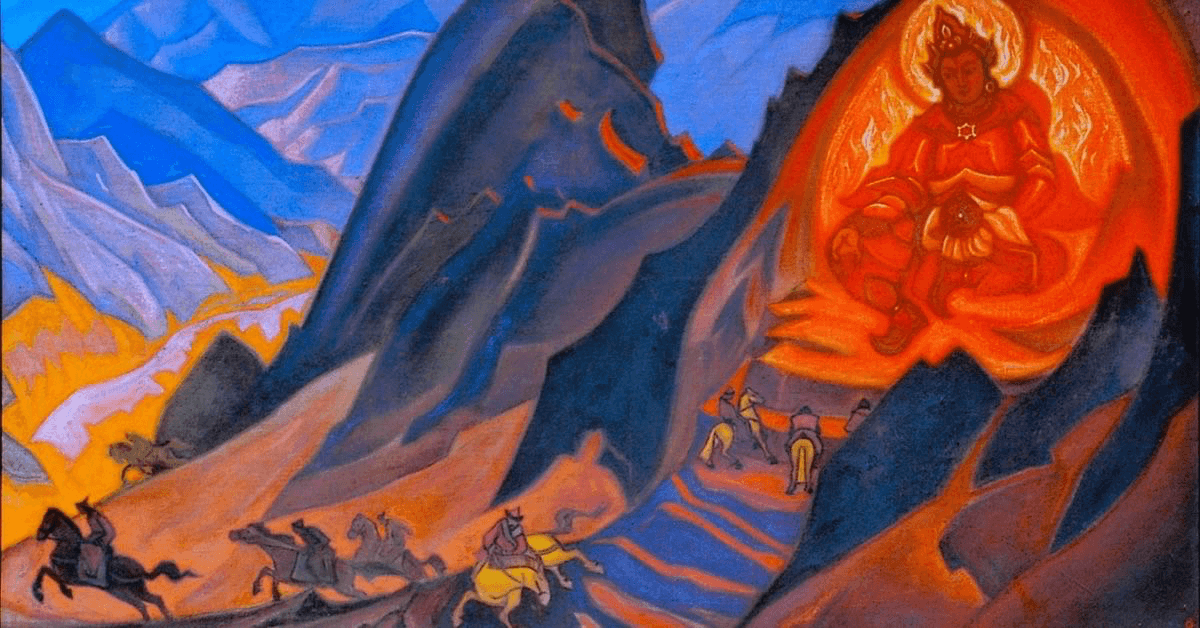
The 20th-century Eurasian artist Nicholas Roerich made India home and explored the Himalayas as the "sacred symbol of spiritual ascent".
In the history of Russian and European art in the first part of 20-th century, the name of Nicholas Roerich was much associated with his archaeological discoveries from the Stone Age. His evocative images of ancient Russia and Slavs found expression in a series of paintings, as well as fairy-tale like stage and costumes designs for S. Diaghilev’s Ballet Russes in Paris and London. At the outbreak of the First World War, Roerich became well known for his pioneering proposal on the protection of cultural monuments during military conflicts, later known as ‘Roerich Pact’ (1935). The artist remained in the annals of Russian art as director of “The Imperial Society for the Encouragement of Arts”- one of the largest public art schools of that time in St. Petersburg and, the head of new art movement known as “Mir Iskusstva” (World of Art).
In 1919, well known Russian writer, Leonid Andreyev compared Roerich’s art to a kingdom in which, he “amidst the visible, discovers the unseen” and creates new world of “enchanting beauty”. Since the artist’s arrival in India in 1923, this magical realm of Roerich, his visual repertoire transformed into a new formal language, steeped in allegories and symbols which paved the way for his paintings of the sacred landscapes of the East. At the foothills of Himalayas – a new phase in Roerich’s life had begun, known as the Indian or Himalayan period, characterized by the creation of many paintings dedicated to the world’s highest mountains. For many years, Roerich developed the Himalayan theme into a deep philosophical and aesthetic doctrine. On the one hand, it reflected his - his spiritual quest and vision, on the other, his scientific explorations and expeditions through the sand dunes of Central Asia and frozen plateaus of Tibet. At the same time, it captured the mythology of these remote regions, its spiritual history captured by the meditating saints and rishis, invoking the great migration of people over time seen against the panorama of the eternal snow of mountain peaks.
“Where can one have such a joy as when the sun is upon the Himalayas, when the blue is more intense than sapphires, when from the far distance the glaciers glitter as incomparable gems. All religions, all teachings, are synthesized in the Himalayas”,[1]-wrote the artist in his article “Treasure of Snow” (1928).
Nicholas Roerich’s art and his personality made a deep impression on many of his contemporaries: poet Rabindranath Tagore, after meeting artist in London in 1920, - wrote an article for magazine 'Arts'(1921) published in New York, emphasizing the unique style and spiritual content of Roerich's paintings. With Tagore’s recommendation the Russian artist’s poems appeared in English translation, in the journal 'Modern Review', in Calcutta in 1920. Roerich ‘s new series of works “Banners of the East”, ”His Country”, “Maitreya”, ”Strongholds of Tibet”, ”Himalayas” and “Kuluta” inspired by his long and trying expeditions to Central Asia and the Himalayan regions were followed up by exhibitions in America, in New York, and Indian cities attracting attention of a wide audience. At the end of artist’s major expedition, in 1928, the family settled in the Kulu Valley in Naggar, with a magnificent view of the valley and the surrounding mountains. Here they established their home and the headquarters of the Urusvati, Himalayan Research Institute, which was founded to study the results of their expeditions. The Institute’s activities included botanical, anthropological and ethnological-linguistic studies, as well as the exploration of archeological sites. From the early1930s, Nicholas Roerich’s paintings appeared on permanent display in Indian museums and private collections. A number of paintings acquired for state museums during these years were occasionally patronized by the ruling families of the Maharajas of Indore, Trivandrum, Mysore, Baroda and others. Besides, municipal authorities, universities and institutions set up the collections of Roerich's art works; amongst them the most prominent collections were in the Allahabad Municipal Museum, and Varanasi’s 'Bharat Kala Bhawan'. Art historian and adviser for the Maharaja of Trivandrum Dr. James H. Cousins initiated an exhibition and the purchase of Roerich’s paintings for the first art gallery – Shri Chitralayam which opened in 1935.The remarkable part of the museum was the fact that special halls named Roerichs were dedicated to the works of Russian Master and his youngest son – Svetoslav. (1904-1993)
During his work and stay in India, Nicholas Roerich also gifted many of his paintings to public institutions, thus creating a certain impulse to start new public museums or collections of artifacts. Collections of well-known institutes like Asiatic Society in Calcutta, Maha Bodhi Society in Sarnath, J.S.Bose Memorial Trust in Calcutta and the Museum of the Theosophical Society in Adyar displayed the elder Roerich’s works. In spite of the distant and isolated location of Kulu valley, Roerich maintained a regular correspondence with prominent public figures, politicians, scientists, artists, poets and writers of the time; amongst them was Rabindranath Tagore and members of his family, Suniti Kumar Chaterjee, Swami Jagadishvarananda, James Henry Cousins, Anagarika Dharmapala, Ramananda Chatterjee, Jawaharlal Nehru, Ordhendra Coomar Ganguly, Bireswar Sen, Asit Kumar Haldar and Rai Krishnadasa. Prolific artist, Roerich also contributed hundreds of articles to Indian journals and periodicals; for more than a decade, a large series of his articles and essays known as ‘Diary Leaves’ was published in English and local languages in Bengal, Tamil Nadu and other states. His books were published in India and abroad such as Altay-Himalaya, Shambhala, Flame in Chalice, Heart of Asia, Realm of Light, Himavat. Diary Leaves, Himalayas -abode of Light, and The Invincible. Remembered as the “Master of Mountains”, Roerich throughout his life had almost a religious reverence for the Himalayas, for, in his visionary universe, these great peaks represented –the sacred symbol of spiritual ascent. Using the methods and technique of the academic realism painting, typical of European art in the first half of 20-th century, artist organically included elements of Asian religions, beliefs, symbols and signs of traditional art into mountain scenery thus, expanding the role and meaning of ‘landscape painting’.
Nicholas Roerich’s art and ideas coincided with the period of cultural revival and national growth that preceded India’s Independence and left an indelible trace on the development India’s artistic movements, particularly the genre of landscape painting, such as, -for the artists of mountain regions like Ladakh, Garhwal, Himachal Pradesh,
Punjab, Uttar Pradesh and Sikkim. In the words of Jawaharlal Nehru – Roerich’s Himalayas
“(…)remind us of so much in our history, our thought, our cultural and spiritual heritage so much not merely of the India of the past but of something that is permanent and eternal about India.”[2]
After 1947, the major collections of Nicholas Roerich’s paintings in India were formed in the Chandigarh Museum and Art Gallery, Chandigarh, the National Gallery of Modern Art in New Delhi, Birla Academy of Art and Culture in Kolkata, as well as N. Roerich Art Gallery in Naggar, Kulu, the Indian Agricultural Research Institute (PUSA) and in Karnataka, the Chitrakala Parishad Gallery in Bangalore. One the largest collection of the artist’s works is on permanent display at Nicholas Roerich Museum in New York which was re-opened in 1949, thanks to the efforts of cultural activists and Roerich’s friends. The Tretyakov State Gallery, the State Museum of Oriental Art, as well as the International Centre of Roerichs in Moscow placed on public display the comprehensive collection of the artist’s paintings. Besides, State Art Gallery in Novosibirsk in separate halls, showing series of works from ‘Himalayan’ period and, the large canvases of the artist, from series “Maitreya”(1925) are exhibited in the Art Museum in Nizhny Novgorod. There is a valuable collection of N.Roerich’s works in the Russian Museum, in St. Petersburg brought to USSR by the elder son, George Roerich in 1958. Collection of Nicholas Roerich in India is indeed one of the largest, ever created by a foreign artist and one of the most representative one, comprising of a few hundred paintings. In 1979 the works of the Russian artist recognized by the Government of India as a part of the National art treasure, along with the works of eight Indian masters. Well known Indian historian and writer Dr. Kalidas Nag called Roerich as “the first Russian ambassador of Beauty who brought to India the deathless message of Art ([1]Nicholas Roerich. Commemorative Volume (New Delhi: 1948, 21.)
Acknowledgement:
Photo and reproductions of paintings courtesy:
Nicholas Roerich Museum in New York, NY, USA.
[1] Roerich, N. 1947, Himalayas-abode of light, Bombay: Nalanda Publications, p.21
[2]Roerich.N. In Memoriam.1948,Bombay,ed. By S.Roerich,p.8
About the Author
Vladimir Zaitsev
Dr. Vladimir Zaitsev is an art historian, museologist, writer, poet, educator, and curator based in New Delhi. He collaborates with the Indira Gandhi National Centre for the Arts (IGNCA), the National Museum Institute, the National Gallery of Modern Art (NGMA), and the Kiran Nadar Museum of Art (KNMA). In recent years, he has curated several exhibitions on Russian and European art.