From Ayni to Chabahar: India’s Strategic Retreat from Central Asia?
Press Information Bureau, India
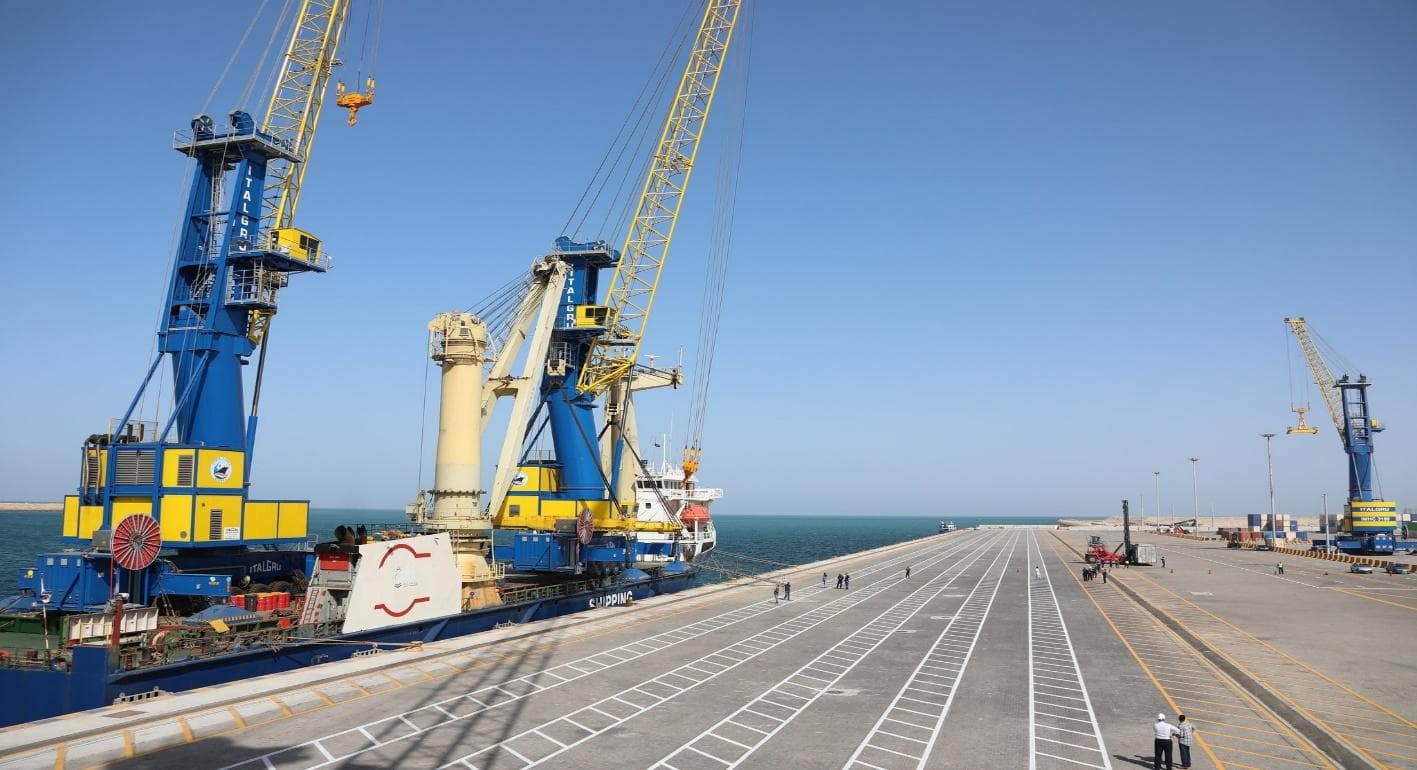
A view of the Shahid Beheshti terminal at Chabahar Port, Iran
For the last two decades, India tried to expand its presence in its extended neighbourhood, a set of regions beyond South Asia which significantly affect its growth and security. While the extended neighbourhood approach towards West Asia and East Asia was relatively successful, registering significant growth in terms of trade and investments in the last decade, Central Asia continues to lie on the outskirts of India’s Extended Neighbourhood despite tall claims. The latest developments in the region, such as India’s exit from the Ayni Airbase in Tajikistan last year, and more significantly, its decision to pull out of the Chabahar port project following the expiring US sanctions' exemption will diminish India’s presence in Central Asia. The ongoing US-Israeli attack on Iran and rising Chinese and Pakistani footprint in the region might further signal India’s strategic retreat from a geopolitically significant Eurasia.
Central Asia’s significance in India’s Extended Neighbourhood
For much of the post-Soviet period, Indian policy makers and analysts acknowledged India’s strategic interests in Central Asia, emphasising its immense hydrocarbon and critical mineral reserves. The region’s significance was further supported by South Asia’s historical linkages with Central Asia, as for several centuries, the Silk Road was the conduit of Eurasian continental trade and the site of hybridisation of cultures across Eurasia. From a regional security perspective, India’s security was closely tied to the region as its threat perceptions and many of its ruling dynasties originated from Central Asia. Meanwhile, India realised it had limited options and instruments to project influence in the region despite its importance in Eurasian geopolitics.
Following the dissolution of the Soviet Union, India recognised the newly independent Central Asian republics, terming the region “high priority”. However, domestic economic restructuring in India and post-Soviet economic headwinds and political instability in Central Asia kept bilateral trade below the potential. Despite inconsequential trade turnover as part of each other’s total foreign trade, India continued to reiterate Central Asia’s significance in the extended neighbourhood. Focusing on high-level diplomatic outreach to the region, Prime Minister Narendra Modi’s visited all the five Central Asian republics in 2015, a first in India’s diplomatic history. Regional security was another area of concern for India as the spread of religious fundamentalism and extremism from the Afghanistan-Pakistan region made it necessary to have a security presence in Central Asia.
India’s connectivity push in Central Asia in the Post-Cold War era
Riding on the geopolitical momentum of the twenty-first century and in response to emerging energy and human security challenges, India shifted it geoeconomic approach to the region. It signed the multi-modal International North South Transport Corridor in 2000 with Russia and Iran to develop overland trade between India, Iran and Russia, with the objective to reach markets in Central Asia and Europe. Following years of negotiations over funding, customs regulations, and other operational bottlenecks, India soon realised the importance of Iran in connecting with Central Asia and Afghanistan. The INSTC’s transnational scale and huge investment demands, however, nudged India to develop more regionally-oriented, Iran-linked infrastructure to connect with Central Asia.
Chabahar and the illusion of regional connectivity
In 2015, India signed the Chabahar port project with Iran, projecting it as a gateway to Central Asia and to deliver humanitarian aid to Afghanistan. Iran’s only deep-water sea port, Chabahar addressed Indian concerns over Pakistan’s denial of overland access to Afghanistan. The port’s regional profile rose when India signed the Ashgabat Agreement in 2018, and in 2021, proposed Chabahar’s integration in INSTC, projecting Indian influence in the region for the first time. India endorsed the port’s regional utility by successfully lobbying the US government to exempt Chabahar from sanctions. In May 2024, India’s Indian Ports Global Limited (IPGL) signed a ten-year contract with Iran’s Port and Maritime Organisation (PMO) to develop the Shahid-Beheshti terminal of Chabahar port, committing $120 million for developing the port and offering a $250 million line of credit for expanding Chabahar-related regional infrastructure.
India’s ad hoc approach to Central Asia
Evidentially, Chabahar became the lodestar of India’s connectivity push with Central Asia in the last decade. It was also projected as India’s only viable land-link with Afghanistan, delivering over 2.5 million tons of wheat and humanitarian aid during the Covid-19 pandemic to the embattled country. India’s bilateral trade with Central Asian republics also doubled in the last decade, partly due to Chabahar’s operationalalisation and due to strengthening of the institutional framework of relations through dialogue and summit-level frameworks in 2019 and 2022. Modest growth in India-Central Asia trade notwithstanding, the quantum of trade still remains much less than that of Russia, China and Turkey’s trade with the region. Nevertheless, India’s excellent relations with Iran and Central Asia made Chabahar a successful example of India’s regional diplomacy in an otherwise complex region, giving landlocked Central Asian countries access to the Indian Ocean.
US sanctions on Iran and India’s Strategic Retreat from Central Asia
India’s optimism over its foreign policy posturing of strategic autonomy, however, turned to be short lived in the wake of the US President’s twenty-five percent tariffs threat to countries doing trade with Iran early this year. Facing rising US pressure, India had already been reducing oil and gas imports from Iran, with bilateral trade going down from $17 billion in 2018-2019 to $1.68 billion in 2024-2025, but the latest US threat comes as a significant setback. The Economic Times reported early this year that following US’ sanctions exemption expiring in September last year, India had begun winding up operations at Chabahar, transferring the remaining financial commitment to Iran and exiting from operations at the port.
This news comes at the backdrop of another revelation in October last year that India had exited the Ayni Airbase, a small functional airbase on the outskirt of the Tajik capital of Dushanbe, which India refurbished in the early 2000s and used as a listening post near the Tajik-Afghan border. The exit from Ayni Airbase last year was still seen as a symbolic loss. However, the winding up of Indian operations at Chabahar, a project in which India has invested close to half a billion dollars and extensive diplomatic capital, will have lasting repercussions.
On a bilateral level, India’s already strained trade ties with Iran comes in the backdrop of the rapidly evolving situation in West Asia. As the US-Israeli attack on Iran unfolds, reports suggest aerial damage around the port city of Chabahar, even though there is no damage reported at the India operated Shahid Beheshti terminal. However, the Israeli-US strikes on Iran’s critical infrastructure will complicate India’s limited operational role in the port, and discourage private investment in the future. In a region which India considers its extended neighbourhood, stepping down from Chabahar without an alternative will undermine India’s already limited engagement with Central Asia. On the other hand, it will strengthen Pakistan’s credibility to the Central Asian republics for accessing the Indian ocean through Chinese-led BRI infrastructure. In the wider region, ceding space to China and Pakistan will erode India’s long-term presence in Eurasia.
About the Author
Rahul Gupta
Rahul Gupta is a Senior Research Fellow with the Centre for Russian and Central Asian Studies at the School of International Studies, Jawaharlal Nehru University, New Delhi, India. He is currently pursuing a PhD at the same institution. His research interests include Eurasian geopolitics, regional connectivity between South and Central Asia, and international organisations in the Global South, with a focus on BRICS and SCO. An early career researcher specialising in post-Soviet studies, he has published extensively, including with SAGE, Routledge and the London School of Economics and Political Science Review of Books. He is also the Founder Director of India Eurasia Research Forum (IERF).